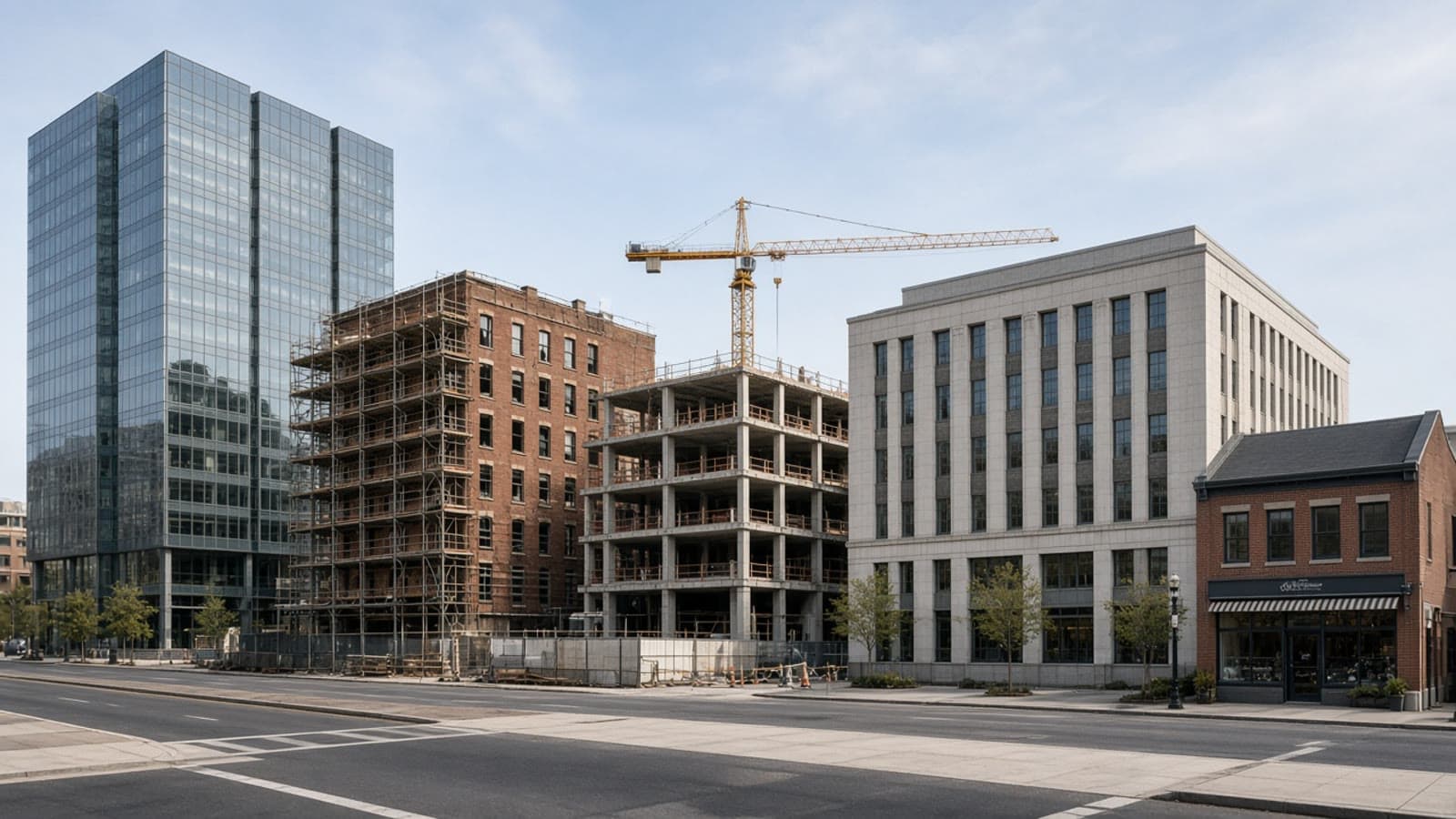
Not all commercial real estate debt works the same way. Here's how the five most common CRE loan types compare on rate, leverage, and use case, based on current market pricing.
On this page
Not all commercial real estate debt works the same way. The right loan type depends on the deal's stage — stabilized and cash-flowing, mid-renovation, or ground-up — and getting it wrong can mean overpaying for capital or getting turned down entirely. Here's how the five most common CRE loan types compare on rate, leverage, and use case, based on current market pricing.
The 5 main types of CRE loans
- Conventional / Permanent — long-term financing (typically 5–30 years) for stabilized, income-producing properties. The lowest-cost option for a property that's already leased up and cash-flowing.
- Bridge — short-term (12–36 months), interest-only financing that funds a property through a transitional period before permanent financing is in place. Built for speed, not for the long haul.
- Construction — funds ground-up development or major renovation, released in draws as work is completed. Converts to permanent financing or gets refinanced once the certificate of occupancy is issued.
- CMBS (Commercial Mortgage-Backed Securities) — non-recourse, fixed-rate permanent loans pooled and sold to bond investors. Favors larger, stabilized deals where non-recourse terms matter more than flexibility.
- SBA 7(a) / 504 — government-backed loans for owner-occupied commercial real estate, aimed at small businesses buying the building they operate out of rather than investors.
Current rate comparison
| Loan Type | Typical Rate Range | Typical Max Leverage | Typical Term |
|---|---|---|---|
| Conventional / Permanent | 5.75% – 9.05% | 75% – 85% LTV | 3 – 15 years |
| Bridge | 5.75% – 12.75% | 70% – 75% LTV | 12 – 36 months |
| Construction | 5.50% – 8.75% | 60% – 75% LTC | 12 – 36 months (interest-only) |
| CMBS | 6.55% – 8.30% | Up to 75% LTV | 5 – 10 years fixed |
| SBA 7(a) / 504 | 5.75% – 8.75% | Up to 90% LTV/LTC | 10 – 25 years |
Which one fits your deal?
Buying a stabilized, leased-up property? Conventional or agency permanent financing is almost always the cheapest option, provided the deal cash-flows well enough to hit lender DSCR minimums.
Acquiring a value-add deal that doesn't yet qualify for permanent debt? A bridge loan buys time to renovate, re-lease, and stabilize before refinancing — at a real cost premium for that flexibility and speed.
Building from the ground up? Construction financing is purpose-built for the draw schedule and risk profile of development, and virtually always converts to a different loan type once the project is complete.
Closing a larger, non-recourse deal? CMBS trades some flexibility (defeasance/yield maintenance instead of a simple prepay) for non-recourse terms and often competitive fixed pricing on bigger loan sizes.
Buying the building your business operates out of? SBA 504 and 7(a) programs offer some of the lowest rates and highest leverage available, but they require majority owner-occupancy — they aren't available to pure investors.
Frequently asked questions
What's the cheapest type of commercial real estate loan?
Conventional bank and agency permanent financing, along with SBA 504 for owner-occupied deals, generally offer the lowest rates — both can run below 6% for the strongest borrowers.
What's the most expensive type of CRE loan?
Bridge and hard money financing carry the widest range and highest ceiling, often running well into double digits for higher-leverage or lower-quality deals.
Can a bridge loan convert into a permanent loan?
Not automatically — a bridge loan is refinanced into permanent debt (or sold) once the property stabilizes; the two are separate loans, even when they're with the same lender.
Do all these loan types require the same DSCR?
No — requirements vary meaningfully by loan type and property type, generally running higher for hospitality and specialty assets and lower for agency multifamily and owner-occupied SBA deals.
How Lev helps
Lev is an AI-powered CRE financing platform that matches sponsors, brokers, and investors to the right lenders across all five loan types — based on asset type, loan size, LTV/LTC, and exit strategy — and manages the process from term sheet to close.
Data: CommercialLoanDirect rate averages as of September 9, 2026; industry sources including Nav and CLS Commercial Real Estate.
Another perspective.
All articles
SBA 504 Loans for Owner-Occupied CRE: A 2026 Guide
For small businesses buying the building they operate out of, the SBA 504 loan remains one of the few fixed-rate, below-market financing paths left. Here's how the structure, 2026 rates, and qualifications work.
What Is DSCR? How Lenders Calculate Debt Service Coverage in 2026
Debt service coverage ratio (DSCR) is the single number most commercial real estate lenders lean on to answer one question: can this property pay for its own debt? Here's how it's calculated, what lenders expect in 2026, and why it matters more than your credit score on most commercial deals.
What Is a Bridge Loan? A Plain-English Guide for 2026
Commercial bridge loans are short-term, interest-only financing — typically 12 to 36 months — used when a deal isn't ready for permanent debt. Here's how they price and underwrite in 2026.