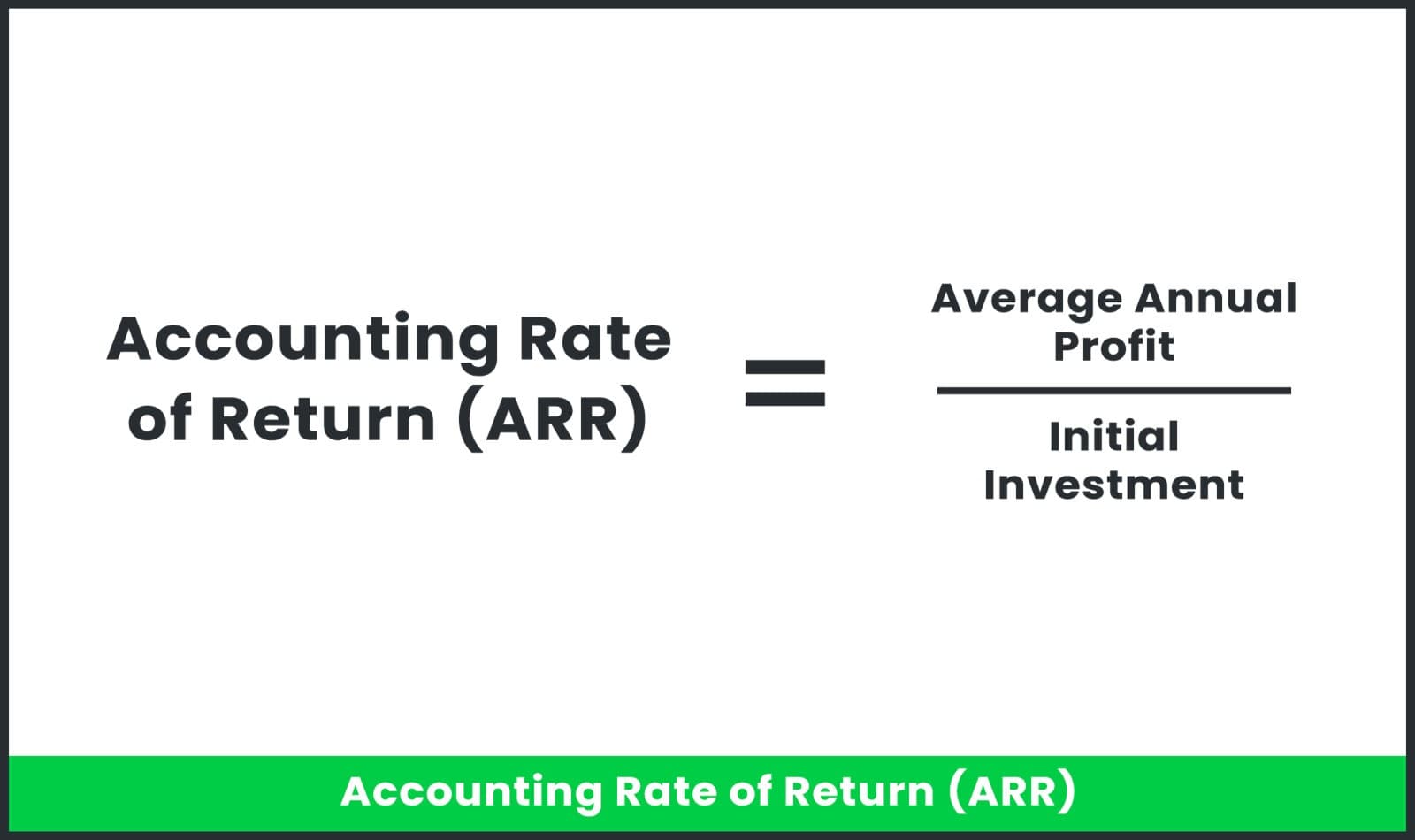
Accounting rate of return is a formula that determines the percentage rate of return on an asset or investment, compared to its initial cost.
On this page
Accounting rate of return (ARR) is a formula that determines the percentage rate of return on an asset or investment, compared to the initial cost of that asset or investment. The ARR divides the average revenue of the investment by the initial cost of the investment to reach a ratio or percentage.
Calculating the Accounting Rate of Return
The formula for ARR takes the average annual profit, divided by the initial investment:
ARR = Average Annual Profit / Initial Investment
To determine these numbers, first you need to calculate the annual net profit from the investment. This annual net profit would include revenue minus expenses. Then you can subtract depreciation. In the case of commercial real estate, if your property has depreciated in value, you can subtract that from the net profit.
Once you’ve arrived at the annual net profit, you can divide that by the initial cost of the investment — or the property cost for commercial real estate purposes. From there, you should have a decimal amount, which you can multiply by 100 in order to arrive at the percentage.
Why Calculate the ARR?
Figuring out your ARR is useful when trying to determine how profitable an investment is or will become. Many businesses use the ARR to determine the success of their investments or assets.
Example of ARR in Commercial Real Estate
Let’s say you purchase a retail property for $1 million dollars. That $1 million is your initial investment. If you estimate $200,000 in revenue per year, then your ARR would be:
$200,000 (annual revenue)/$1 million (initial cost) = 0.2, or 20%
So, the annual rate of return on your investment is 20%.
ARR Limitations and Considerations
Although the ARR is a useful tool in determining profits, there are some limitations. For starters, ARR doesn’t take into account the time value of money (TVM).
TVM is the idea that money available in present time is worth more than that same sum of money in the future because of earning capacity.
For instance, some investments might earn more money in early years, while others might earn more money later, creating an uneven revenue stream each year. However, ARR doesn’t take these timelines into consideration, and profits that arrive earlier could be reinvested to earn even more money.
Essentially, ARR doesn’t take into account the increased risk and uncertainty of longer-term investments.
What Is Required Rate of Return?
Required rate of return (RRR), sometimes called the “hurdle rate” is the minimum ARR an investor would accept on an asset or investment. The RRR number varies depending on the investor and their levels of risk tolerance. For instance, an investor with a low risk tolerance would require a higher rate of return on their investment than one with a high risk tolerance.
Another perspective.
All articles
Rent roll in commercial real estate: what it is, what it shows, and how to read one
A rent roll is the most-read document in any CRE deal. Learn what a rent roll shows, the columns lenders and buyers scrutinize, and the red flags to spot.

What Is a Leasehold Estate in Commercial Real Estate?
Leasehold estate is a commercial real estate term that describes a lease agreement in which a tenant has some property ownership rights.

Estoppel certificate in commercial real estate: what it is, who uses it, and why every closing needs one
An estoppel certificate is what tenants sign to verify lease terms in a CRE sale or financing. Learn what it covers, who needs it, and how to negotiate it.