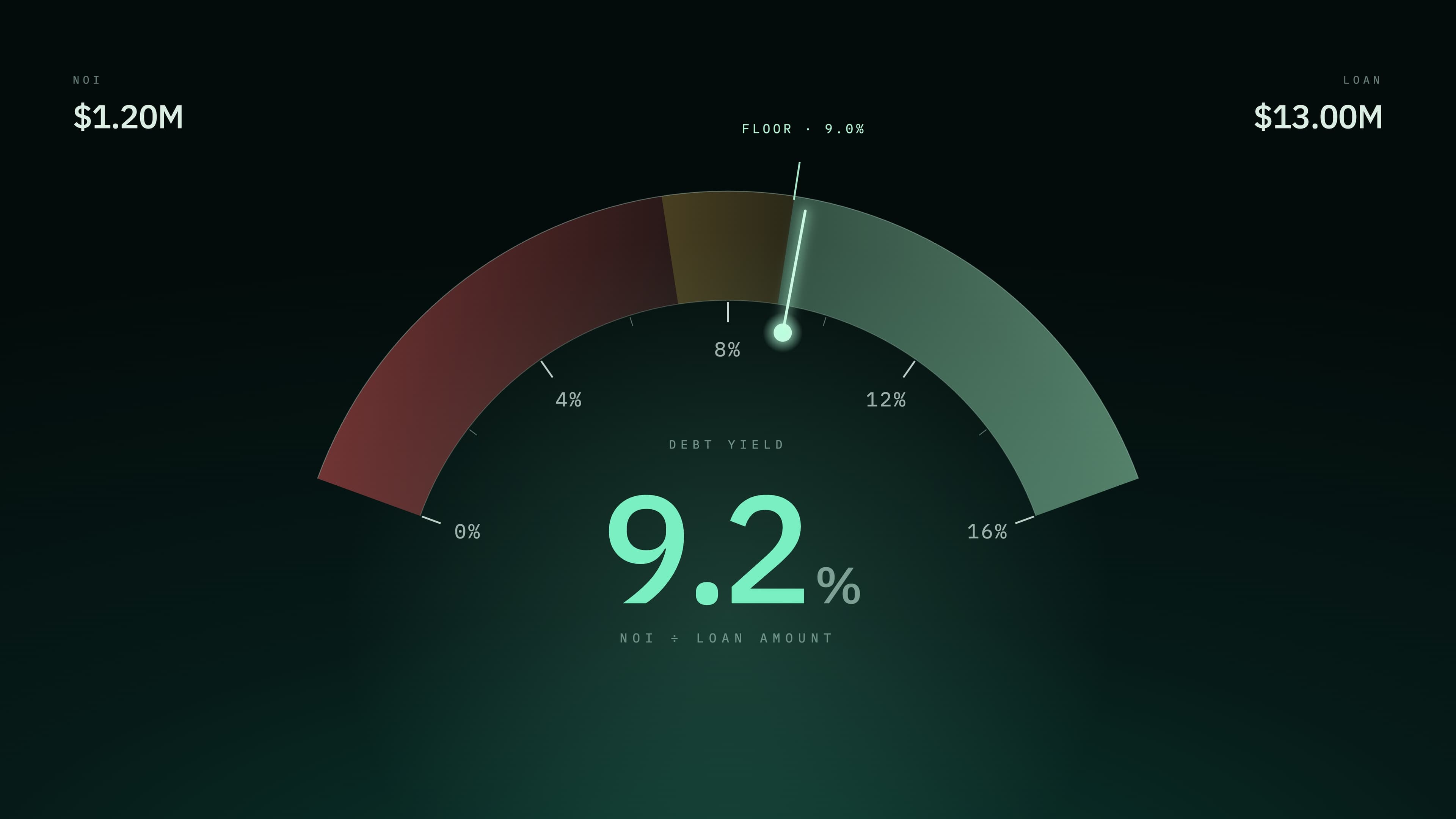
When commercial real estate lenders size a loan, they don't rely on a single number. They run three different lens checks: loan-to-value (LTV), debt service coverage ratio (DSCR), and debt yield. The first two get most of the borrower attention, but debt yield is often the constraint that quietly determines maximum loan size, especially on properties in high-cap-rate markets or with thin operating margins. Borrowers and brokers who understand debt yield can anticipate lender feedback before the term sheet comes back, and that anticipation often makes the difference between a clean closing and a frustrating renegotiation.
Debt yield is conceptually simpler than DSCR or LTV. It asks one question: if the lender had to take this property back and operate it themselves, what cash flow yield would they be earning on the loan amount? A lender that funds a $10 million loan against a property producing $1 million of NOI is earning a 10% debt yield. The same loan against a property producing $600,000 of NOI is earning a 6% debt yield, and most lenders won't touch it.
This guide walks through what debt yield is, how it's calculated, why lenders rely on it alongside DSCR and LTV, what makes a "good" debt yield by property type, and how borrowers and brokers can use the metric to negotiate better outcomes. If you'd rather skip the math and get matched directly with lenders whose debt yield criteria your deal fits, Lev does that automatically.
What is debt yield?
Debt yield is the property's net operating income divided by the loan amount, expressed as a percentage. The formula:
Debt Yield = Net Operating Income (NOI) / Loan Amount
A debt yield of 10% means the property's annual NOI equals 10% of the loan balance. A debt yield of 7% means the NOI equals only 7% of the loan balance. Lenders interpret debt yield as the unlevered cash flow yield they'd earn if they had to take ownership and run the property themselves.
Unlike DSCR (which depends on the interest rate and amortization schedule) and LTV (which depends on the appraised value), debt yield depends only on two property-specific numbers: NOI and loan amount. That makes it a remarkably stable metric across interest rate environments. A property's DSCR can collapse from 1.40 to 1.05 if interest rates rise 200 basis points. A property's LTV can swing if cap rates compress or expand. But a property's debt yield at a given loan size stays the same regardless of what's happening in the broader market.
That stability is exactly why lenders started using debt yield more heavily after the 2008 financial crisis. In that downturn, lenders learned that LTV and DSCR could both look healthy at origination but mask underlying property cash flow weakness. A 70% LTV loan on a property at an overheated cap rate could become a 95% LTV loan three years later when cap rates corrected. A 1.30 DSCR loan at 4.5% rates could become a 0.95 DSCR loan if rates jumped to 7%. Debt yield, by contrast, only changes if NOI changes, which gave lenders a more reliable signal of underlying credit quality.
How to calculate debt yield: a worked example
The math is straightforward. Walk through it on a real-ish example.
A 50,000 square foot industrial property is being acquired for $7,500,000. The property generates the following income:
- Annual rent: $750,000
- Other income (parking, signage): $25,000
- Effective gross income: $775,000
- Operating expenses (taxes, insurance, maintenance, management): $175,000
- NOI: $600,000
The borrower is requesting a $5,000,000 senior loan. The debt yield calculation:
Debt Yield = $600,000 / $5,000,000 = 12.0%
A 12% debt yield is healthy. Most senior lenders writing on industrial would be comfortable here, and the loan should size to the borrower's request without debt yield being a binding constraint.
Now consider the same property but with $400,000 of NOI instead of $600,000 (maybe because two tenants have vacated and the rent roll is partially exposed). The borrower still wants a $5,000,000 loan. The debt yield:
Debt Yield = $400,000 / $5,000,000 = 8.0%
An 8% debt yield is borderline. Some lenders will still write the loan at that level, but many won't go below 9%. If the lender's debt yield floor is 9%, the maximum loan size is:
Maximum Loan = NOI / Required Debt Yield = $400,000 / 9.0% = $4,444,444
The lender will cap the loan at $4.44 million regardless of whether DSCR or LTV would have supported a larger number. Debt yield is the binding constraint.
This is the central use case for debt yield in lending: it caps loan size when NOI is thin relative to the requested loan amount, even when DSCR and LTV would otherwise allow more leverage.
Why lenders use debt yield alongside DSCR and LTV
Each of the three sizing metrics protects the lender against a different risk:
LTV protects against valuation risk. If property values fall, a low LTV gives the lender a cushion before the loan goes underwater.
DSCR protects against cash flow timing risk. If the property's cash flow softens or interest rates rise, a high DSCR gives the loan room to keep servicing.
Debt yield protects against both risks at once, in a way that's insulated from cap rate manipulation and interest rate sensitivity. It asks: regardless of what the market is doing, does this property's cash flow support this loan amount?
A simple thought experiment shows why debt yield is useful. Imagine two properties, both producing $500,000 of NOI:
- Property A is in a primary market with a 4.5% cap rate. Appraised value: $11.1 million.
- Property B is in a secondary market with a 7.5% cap rate. Appraised value: $6.7 million.
Both properties get appraised for an LTV-based loan. At 70% LTV:
- Property A loan: $7.7 million
- Property B loan: $4.7 million
At a 6% interest rate, 30-year amortization, the DSCR for both is roughly:
- Property A: $500,000 / $554,000 = 0.90 (loan doesn't service)
- Property B: $500,000 / $338,000 = 1.48 (loan services comfortably)
Debt yield:
- Property A: $500,000 / $7,700,000 = 6.5% (low)
- Property B: $500,000 / $4,700,000 = 10.6% (healthy)
The lender's appetite for Property A at $7.7 million is questionable. DSCR fails immediately, and even if interest rates were lower, the debt yield is thin. The lender would likely cap the loan at $4.5 million to bring debt yield to 11% and DSCR comfortably above 1.20. Property B, despite trading at a lower price, supports the LTV-based loan without debt yield concerns.
Debt yield surfaced this issue immediately, whereas LTV alone would have implied $7.7 million was fine.
What's a "good" debt yield?
There's no single answer. Required debt yield varies by property type, lender type, market, and economic environment. General ranges:
Stabilized multifamily (agency loans): 7.5 to 9.0%. Fannie Mae and Freddie Mac are the deepest lenders here and have more flexibility on debt yield than other lenders. In a low-cap-rate environment, agency debt yield minimums are often the binding constraint on multifamily loan sizing.
Stabilized multifamily (bank or life co): 8.5 to 10.0%. Banks and life cos typically require modestly higher debt yields than the agencies because they're not securitizing the loan.
Stabilized office, retail, industrial (life insurance / CMBS): 9.0 to 11.0%. Higher than multifamily because of the additional cash flow risk in these property types.
Bridge / value-add (debt funds, private credit): 7.5 to 9.0% on a stabilized basis (debt yield on projected stabilized NOI, not on day-one NOI). Bridge lenders are often more flexible on going-in debt yield because the business plan is to grow NOI.
Hospitality / special-purpose: 11.0 to 13.0%+. Hotels, self-storage with stabilization questions, and other higher-cash-flow-risk properties get higher debt yield requirements.
Construction loans: typically not measured by debt yield at origination (no NOI yet), but a "stabilized debt yield" is often modeled to compare to permanent loan refi capacity.
These ranges are guidelines, not hard rules. A strong sponsor with a track record and a relationship can negotiate softer debt yield floors, while a weaker sponsor on a marginal deal will face tighter requirements. Market conditions also matter: in a frothy capital market, debt yields trend lower as lenders compete on terms; in a tight credit environment, debt yields trend higher.
How debt yield differs from cap rate
Debt yield and cap rate look similar (both are NOI divided by a dollar amount), but they measure different things:
Cap Rate = NOI / Property Value Debt Yield = NOI / Loan Amount
Cap rate measures the unlevered yield on the property's value. Debt yield measures the unlevered yield on the loan amount. The relationship between them is determined by leverage:
Debt Yield = Cap Rate / LTV
For example: a property at a 6% cap rate financed at 70% LTV has a debt yield of 6.0 / 0.70 = 8.6%. Same property at 60% LTV: 6.0 / 0.60 = 10.0%. Lower leverage produces a higher debt yield, which is why lenders sometimes cap LTV at a level that achieves their debt yield floor.
This relationship is also why low-cap-rate properties are harder to lever fully. A property at a 4.5% cap rate would need very low LTV (below 50%) to achieve a 9% debt yield. A property at a 7% cap rate can be levered to 70% and still hit 10% debt yield. Cap rate compression in primary markets has put pressure on debt yields and made lenders more cautious about high-leverage permanent loans in those markets.
Using debt yield to estimate maximum loan size
For borrowers and brokers, the practical use of debt yield is forecasting how much loan a property will support before applying to lenders. The formula:
Maximum Loan (per debt yield) = NOI / Lender's Debt Yield Floor
Run this calculation alongside the LTV and DSCR maximums to identify which is the binding constraint. The maximum supportable loan is the smallest of the three:
Maximum Supportable Loan = min(LTV-based max, DSCR-based max, Debt-Yield-based max)
Walking through an example. A multifamily property:
- NOI: $1,200,000
- Appraised value: $18,000,000
- Lender's terms: 70% LTV max, 1.25 DSCR min, 9.0% debt yield min, 6.5% interest, 30-year amort
Calculate each maximum:
LTV-based max: 70% × $18,000,000 = $12,600,000
DSCR-based max: this requires solving for the loan amount where NOI / annual debt service = 1.25. At 6.5% / 30-year amort, the annual debt service factor is roughly 7.59% of the loan balance. So: $1,200,000 / 1.25 = $960,000 max debt service. $960,000 / 7.59% = $12,648,000.
Debt-yield-based max: $1,200,000 / 9.0% = $13,333,333.
The smallest of the three is LTV at $12.6 million. LTV is the binding constraint, debt yield is comfortably above the floor, and DSCR is close but not the binding constraint.
Now imagine the same property in a high-cap-rate environment where the appraisal comes in at $13,000,000 instead of $18,000,000. The new maximums:
LTV-based max: 70% × $13,000,000 = $9,100,000 DSCR-based max: $12,648,000 (unchanged, DSCR doesn't depend on value) Debt-yield-based max: $13,333,333 (unchanged, debt yield doesn't depend on value)
Now LTV is dramatically the binding constraint at $9.1 million.
And in a different scenario: lower NOI of $850,000 with the same $18 million value:
LTV-based max: $12,600,000 DSCR-based max: $850,000 / 1.25 / 7.59% = $8,959,789 Debt-yield-based max: $850,000 / 9.0% = $9,444,444
DSCR is the binding constraint here at roughly $8.96 million.
And finally: same NOI of $850,000 but at a tighter 11% debt yield floor (common for office or retail):
LTV-based max: $12,600,000 DSCR-based max: $8,959,789 Debt-yield-based max: $850,000 / 11.0% = $7,727,272
Now debt yield is the binding constraint at $7.7 million.
The exercise shows how the three metrics interact. Different properties hit different binding constraints. Knowing which constraint is likely to bind on your deal helps you anticipate lender feedback and structure the request realistically.
Strategies to improve debt yield
Debt yield is a function of NOI and loan amount. The two ways to improve it:
Increase NOI: raise rents, reduce expenses, improve occupancy, sign higher-credit tenants on longer leases, capture below-market mark-to-market opportunities. The slow path, but it's how value-add business plans typically work.
Reduce loan size: ask for less debt. This is the immediate path. If a property doesn't support the loan amount you wanted, downsize the request and increase the equity.
For value-add deals, lenders will often underwrite a stabilized debt yield (debt yield based on the projected NOI after the business plan executes) rather than going-in debt yield. This expands what's financeable on day one if the lender believes the path to higher NOI is credible.
For deals where current NOI is constrained by short-term issues (recent vacancy, market-lease lag), bridge lenders are often a better fit than permanent lenders. Bridge lenders can tolerate lower going-in debt yields because the loan is short-term and the exit is a refi to permanent at a higher stabilized NOI.
For more on how lenders structure the senior debt position alongside other capital layers, see Lev's capital stacking guide.
How debt yield ties into the broader underwriting framework
Debt yield is one piece of a multi-metric underwriting framework. The full picture for a senior loan includes:
Property level: NOI, occupancy, lease structure, rent roll quality, capex requirements, market fundamentals Loan level: LTV, DSCR, debt yield, amortization, term, prepayment Sponsor level: experience, track record, net worth, liquidity, banking relationships Market level: cap rates, comparable sales, rent comps, submarket pipeline
Debt yield is the only one of these metrics that's purely a property-cash-flow-vs-loan-size measure. That makes it especially useful for cross-property comparisons. Lenders can rank their deal pipeline by debt yield and quickly understand which deals are richer in underlying credit quality, separate from how the appraisal came in.
For a deeper walkthrough of how DSCR fits into this picture, see Lev's DSCR guide. For LTV, see Lev's loan-to-value ratio walkthrough.
Frequently asked questions
What's the difference between debt yield and DSCR?
Both measure cash-flow protection, but in different ways. DSCR compares NOI to annual debt service (which includes interest, principal amortization, and the interest rate). Debt yield compares NOI to the loan amount itself, with no rate or amortization assumption. DSCR moves with rates; debt yield doesn't. Lenders use both to triangulate the loan's risk profile.
Can a property have a strong DSCR but a weak debt yield?
Yes. A low-rate, interest-only loan can produce a strong DSCR even when debt yield is thin. Example: a $10 million loan at 4% interest-only against a property producing $500,000 of NOI has DSCR of 1.25 (which clears most lender thresholds) but debt yield of only 5% (which fails most lenders). Debt yield was introduced precisely to catch deals where low rates and IO terms were masking underlying cash flow weakness.
What's a "stabilized debt yield"?
Debt yield calculated on the property's projected NOI after the business plan executes (lease-up, capex, etc.), rather than on day-one NOI. Common in bridge and value-add underwriting. Lenders agree to lower going-in debt yield in exchange for evidence that the stabilized debt yield (the lender's true exit) will be solid.
Why don't borrowers see debt yield in commercial mortgage marketing?
Borrowers see headline rates, LTV, and DSCR all the time, but debt yield rarely appears in marketing because it's primarily a sizing tool for the lender. Once the lender has sized the loan, the borrower mostly cares about rate, LTV, and DSCR. Debt yield was the constraint that determined the loan size, but it doesn't show up in the final term sheet as prominently.
Does debt yield apply to construction loans?
Not directly at origination, because the property doesn't have stabilized NOI yet. But construction lenders typically underwrite to a stabilized debt yield (the projected debt yield once the property is built and leased) to ensure the construction loan can be refinanced into a permanent loan at maturity.
What's a "minimum debt yield covenant"?
A loan covenant that requires the property to maintain a minimum debt yield throughout the loan term. If actual debt yield falls below the threshold (because NOI drops), the borrower may be required to pay down the loan or post additional collateral. Most common in larger institutional CMBS or balance sheet loans.
How does debt yield interact with cap rate compression?
When cap rates compress (property values rise relative to NOI), high-LTV loans can produce low debt yields, even when LTV looks healthy. Lenders responded to mid-2010s cap rate compression by tightening debt yield floors, which effectively reduced maximum LTVs on low-cap-rate properties. This is why low-cap-rate primary-market properties often max out at lower LTVs than the published lender guidelines suggest.
Is debt yield the same as cash-on-cash return?
No. Cash-on-cash return is the property's after-debt-service cash flow divided by the equity invested (a measure for the equity investor). Debt yield is the property's NOI (before debt service) divided by the loan amount (a measure for the lender). Different stakeholders, different denominators.
How does an investor use debt yield?
Investors often calculate debt yield as a quick check on whether a deal is over-leveraged. If a property's debt yield is below 8% on a stabilized basis, the deal is probably over-financed, and any softness in NOI could cause stress on the debt. Investors evaluating GP-led deals look at debt yield as a discipline check on the sponsor's leverage decisions.
What's the highest debt yield I should ever see?
In the high single digits to mid-teens is typical. Anything significantly above 15% usually means very low leverage or unusually high NOI relative to value, which can suggest either undervalued NOI (likely won't sustain) or unusually conservative debt (probably underleveraged for the asset class).
The takeaway
Debt yield is the lender's discipline metric. It cuts through interest rate noise, cap rate noise, and amortization tricks, and asks one question: does the property's cash flow support this loan size on its own merits? For borrowers and brokers, learning to forecast debt yield before applying to lenders is one of the highest-leverage skills in deal preparation. The right anticipation saves weeks of back-and-forth and produces better terms.
If you're trying to size a senior loan on a deal where debt yield might be the binding constraint, start with Lev to see which lenders' debt yield floors match your property profile and get matched directly with the ones who can do the deal at your target leverage.